
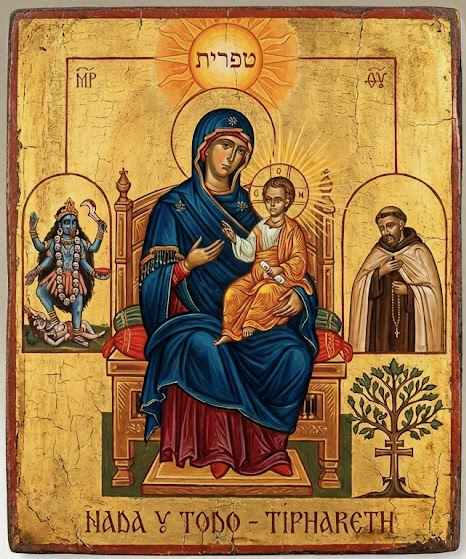
A Christmas Reflection from a Lay Carmelite: Searching for the Truth Behind the Myths
By Jónas Sen
During this holy season, when Christians everywhere celebrate the birth of the Savior, it is wholesome to pause and ask: What are we actually celebrating? For many of us, this inquiry begins with doubt, or even scandal, upon encountering the works of scholars like Elaine Pagels.
We read the book Miracles and Wonder like a thriller, witnessing historical analysis tear apart the glossy image of Sunday School. We face the possibility that the Gospels are not diary entries, but theological fiction. We hear the uncomfortable voices of the past—suggesting that the virgin birth might have been fabricated to cover up rumors that a Roman soldier named Pantera raped Mary and fathered Jesus, and that the miracles are merely misunderstandings of ancient texts.
The initial reaction is logical: If this is true, the Church is simply wrong. It is teaching a false religion. If the history is a lie, how can the faith be true?
But here, a turning point occurs in our thinking. Instead of casting faith aside, we shift from the realm of history to the realm of mysticism. We recall Swami Vivekananda, the great yogi who looked up to Jesus as a Master but rejected the institution. We begin to view Jesus not as a historical fact, but as an Archetype.
In the light of Kabbalah, Jesus appears to us as Tiphareth—Beauty. He is the Sun at the center of the Tree of Life, the mediator connecting the Infinite (Keter) with the Earthly (Malkuth). When He says, “No one comes to the Father except through me,” He is not stating a narrow dogma, but describing a law of consciousness: The way lies through the heart.
This understanding leads us to the core of the matter, which modern thinkers like Sam Harris and the “Waking Up” philosophy have reframed: The Death of the Ego. We realize the Crucifixion is not merely an execution in the past, but a symbolic description of what must occur within us. We look for “the one who looks”—the self—and find nothing but open awareness. In this empty space, this “headlessness,” the illusion of separation dies. Jesus’ words on the cross, “Father, into your hands I commend my spirit,” then become the ultimate surrender of the ego’s control.
But how do we live this in practice? How do we turn philosophy into reality?
Here, our “doors” come into play. As laypeople in the Carmelite tradition, we utilize ancient methods. We pray the Liturgy of the Hours to tune ourselves to the rhythm of the cosmos. We use the Rosary, not as an empty repetition, but as a powerful tool to soothe the “monkey mind.” By reciting the prayers, we keep the surface mind occupied so that the deep silence—St. John of the Cross’s Nada—has space to emerge. We use the altar to prime the nervous system for the sacred.
And in the deepest mystery of the practice, all this merges into a powerful alchemy. We draw wisdom from the East, from the Ramakrishna order, and invoke the power of Kali, the fierce mother who severs the head of the ego and burns away illusions. Yet, we do this while holding the image of the Virgin Mary in our hearts.
By uniting these two mothers—the power to destroy and the gentleness to give birth—we transform the energy. We use Kali’s sword to clear the path, but Mary’s embrace to receive the Christ-consciousness. The myth of the virgin birth ceases to be biological nonsense and becomes a spiritual truth: That God is born only in a pure, open, and humble heart.
Our conclusion is therefore this: The Church may have lost its way in history and become stuck in a literalism that does not withstand scrutiny. But it preserved the vessel. It preserved the myths, the symbols, and the prayers. It is our task to open this vessel.
Christmas is, therefore, not a celebration of the past. It is a celebration of that moment when you sit in silence, let the ego die on the cross of awareness, and allow Tiphareth—the True Light—to be born in the darkness of the heart.
Wishing you a joyous festival of light and inner peace.
 Jónas Sen